
Role of technology in Indian education
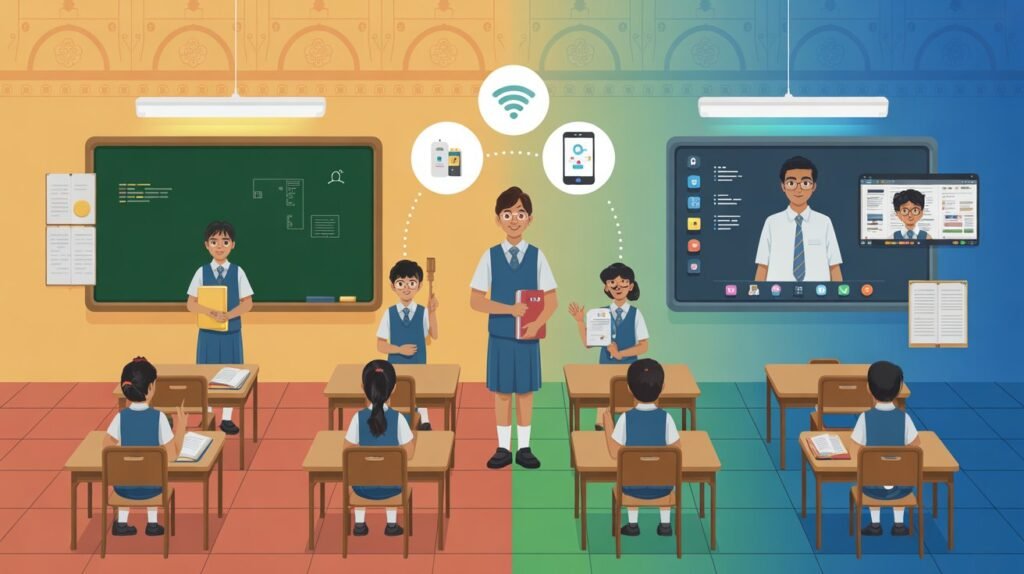
The role of technology in Indian education has become more of a supporting tool and not a tool at the center of learning. The classrooms are not what they were just 10 years ago. Screens are substituting chalkboards. Digital content supports the use of textbooks. Teachers currently apply data and tools to learn more about students. The role of technology in Indian education is not about substituting the teachers. It is concerned with assisting them in their instructing and the pupils in their learning in more intelligent directions. Technology is still becoming a factor in the education in India, as more people and devices become accessible to them and the internet.
Understanding the Role of Technology in Indian Education
The role of technology in Indian education is concerned with digital-powered learning. These technologies are smart classrooms, web services, learning applications, and evaluation systems. Technology simplifies ways of describing complicated concepts. Learning is interesting with the use of visuals, videos, and interactive lessons. The students are able to study at their level of pace. Easy access of progress by teachers. Such a change aids in quality and access.
Technology development in Indian schools.
Indian education in terms of technology did not come in one day. It began with computer laboratories and rudimentary computer programs. Possibilities were increased over time with the use of internet access, with “` becoming more apparent through digital boards and multimedia lessons. There is today a use of cloud platforms and mobile applications in classes. Government and non-government initiatives are as well embracing the use of digitally based tools in rural schools. Such gradual development indicates the extent to which technology is influencing learning.
Learning in interactive and smart classrooms.
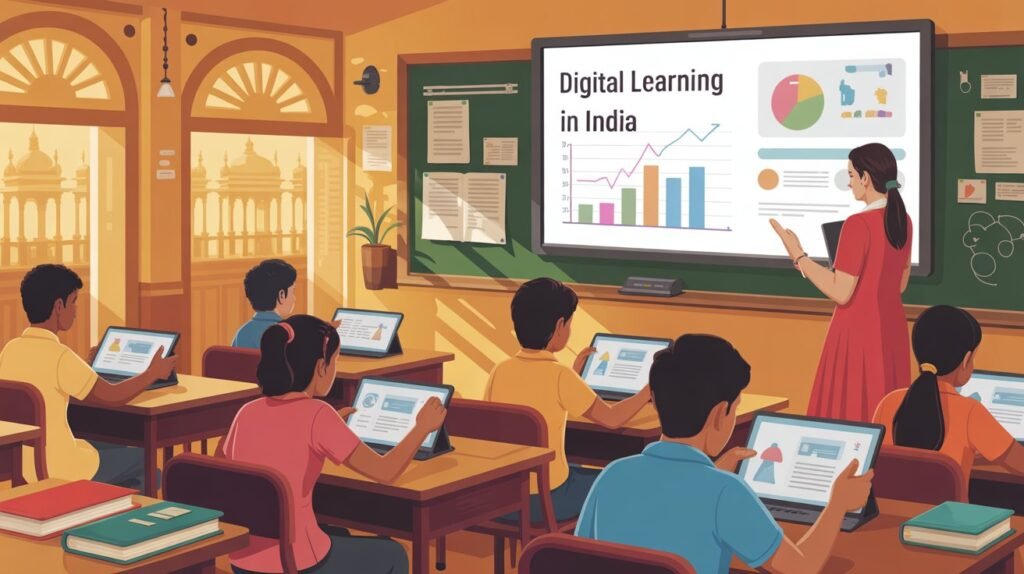
The example of smart classrooms is one of the important ones. Such classrooms utilize digital boards, projectors, and other related equipment. Instructors show movies and schematic illustrations as well as live examples. Students are engaged in activities. The lessons will be more interactive. Smart classrooms endorse the various learning styles. Learners with visual skills learn well. Audio learners stay engaged. Such a method enhances concentration and memorization.
Advantages of smart classroom technology.
Smart classrooms save time. The teachers prepare lessons more quickly. Material is updated without difficulty. The role of technology in Indian education using smart classrooms also facilitates amendment. Taped lessons allow students to have a reiteration of the lessons. The absentees are able to cover the lost time stress-free. Students in schools with smart classrooms are said to have better involvement and increased comprehension among other students.
Artificial intelligence in learning.
AI-based learning is altering personalized learning. The role of technology in Indian education now contains tools based on artificial intelligence. These are the tools used to examine the student’s behavior and performance. They establish strengths and weaknesses. Learning paths change according to this data. Learners receive materials at their level. Tutors through AI assist in the practice and doubt-solving. This makes their learning more effective and oriented.
AI support for teachers
AI also supports teachers. Such processes as grading and attendance are minimized in terms of manual work (AI saves time on teaching). The teachers are more concerned with mentoring than with paperwork. AI tools propose instructional strategies that are dependent on the performance of the classes. This enhances the general classroom performance.
Information analytics and learning analytics.
Data analytics is a nonetheless forceful player. Educational institutions follow the attendance, test results, and activity rates. Patterns emerge. Instructors identify deficits in learning at a young age. Interventions are made promptly. The administrators make use of information to plan the resources more efficiently. Evidence-based practice enhances performance and productivity.
Analytics: enhancing student performance.
Students are directly benefiting when analytics is used properly to see the struggling student. Extra support can be planned. The students who have good performance obtain high-level content. Parents are given progress reports explicitly. Openness enhances cooperation between homes and educational institutions.
Teacher and student online tools.
Online learning is via learning apps, online libraries, and collaboration tools. Students get access to resources at any given time. Notes are immediately shared among the teachers. Teamwork becomes simplified. Online applications promote self-directed study. Another thing is that they develop digital skills required in the future.
Web-based tests and student feedback.
Assessment has also changed. Online exams provide immediate feedback. The role of technology in Indian education provides speedy replying. Students will be aware of their positions. Educators manipulate the lessons. Online tests eliminate bias. They save time and resources. tight system Secure platforms are integrity-sensitive. This enhances the evaluation process.
General access and inclusion in learning.
Technology enables access to education. The role of technology in Indian education goes to remote and underserved locations. The distance is overcome through online content. Assistive tools are useful for students with disabilities. The sound lessons assist the learners who are the visually impaired people. Hearing-impaired students are assisted by subtitles. Inclusive design does not leave anybody behind.
Closing the divides with digital learning.
Digital technologies can also assist in closing social and geographical borders. The role of technology in Indian education assists rural students in getting quality material. There are free resources available through government platforms. Mobile learning is applicable to low bandwidth. Community forms assist in accessing togetherness. Such attempts minimize disparity in learning.
Educator development and improvement.
The teachers will have to become familiar with new tools. Teacher training programs accompany the role of technology in Indian education. The online classes and courses develop online skills. Teachers learn new methods. The peer learning enhances confidence. Well-trained teachers better use technology. This is directly beneficial to students.
Difficulties with technological skills.
Notwithstanding these advances, a number of challenges are still there. Infrastructure gaps impact adoption. The role of technology in Indian education requires connecting to electricity and the internet. These are not available in all schools. Another problem is the affordability of the devices. Teacher readiness varies. To resolve these issues, there is a need for policy support and investment.
Ethical issues and privacy of data.
There comes the responsibility with digital tools. The role of technology in Indian education relates to the issue of data privacy. The information of the students should remain confidential. Platforms should practice ethics. Protected by clear policies, users are guaranteed protection. One can also build trust due to the importance of safety.
Participation by the government and the private sector.
These two industries have roles to play. Digital education is encouraged by government efforts in the country. When cooperation is present, the private companies will develop tools and platforms. Partnerships between the government and the business increase coverage. There is better performance when there are shared goals.
Technology influences education in the long run.
Technology equips and readies students to be problem solvers as well as be digitally capable. Students also become flexible learners. Lifelong learning is achieved. Education is more in tandem with industry requirements. This helps in economic growth and innovation.
Conclusion
The role of technology in Indian education has continued to grow and develop. Technology enhances the teaching and learning results, whether it is a smart classroom application or AI and data analytics. It supports teachers. It empowers students. There are problems, but solutions are surfacing. Having an equal emphasis on access, quality, and ethics, the role of technology in Indian education will build a stronger, more inclusive learning system of tomorrow.
FAQs
What is the role of technology in Indian education?
It assists in enhancing the instructional practices, learning accessibility, and student achievement using digital technologies.
How does AI help in education?
AI individualizes learning and aids teachers in terms of insights and automation.
Are smart classrooms effective for students?
Yes, they advance interaction, comprehension, and learning involvement.