
Government schemes for education in India
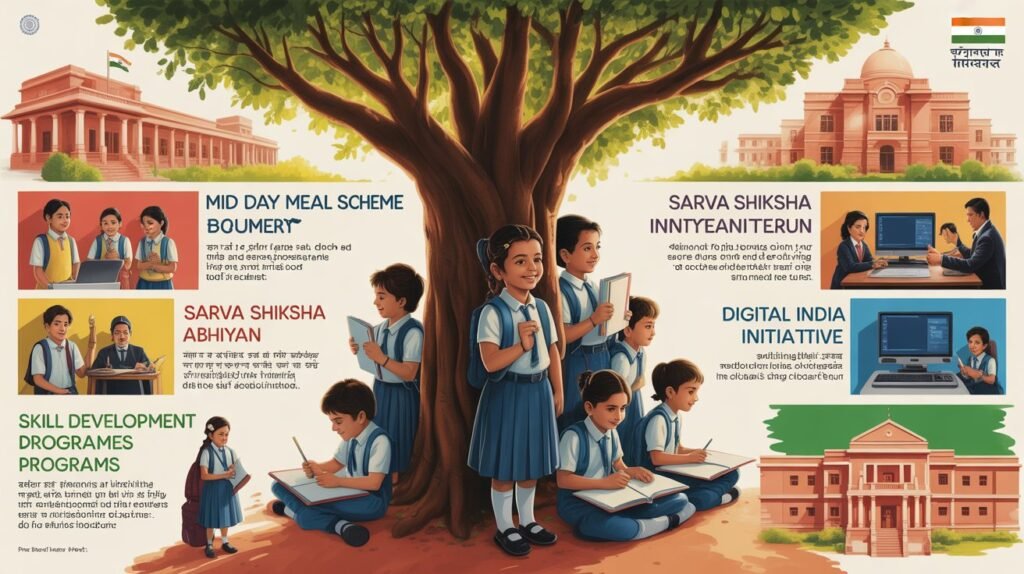
Government schemes for education in India transform the future of future generations of millions of students. Learning in such a diverse nation as the Indian one is not easy. Income disparities, territories, and social divisions influence the accessibility to the learning. They put an emphasis on access, quality, and retention. These schemes assist students in all levels of their education starting in early schooling to higher education. With this continued policy focus, education has become more inclusive and result oriented over the years.
The importance of government aid in education.
Education develops the capacity, self-assurance and chance. Not all families are able to afford good schooling or education. Government schemes for education in India are ensuring that finances do not hinder learning. The programs underpin nutrition, infrastructure, quality of teaching and direct financial support. They also promote equality. The greatest advantage is to girls, country students as well as poor people. Investment in education by people empowers the whole economy.
Overview of Government schemes for education in India
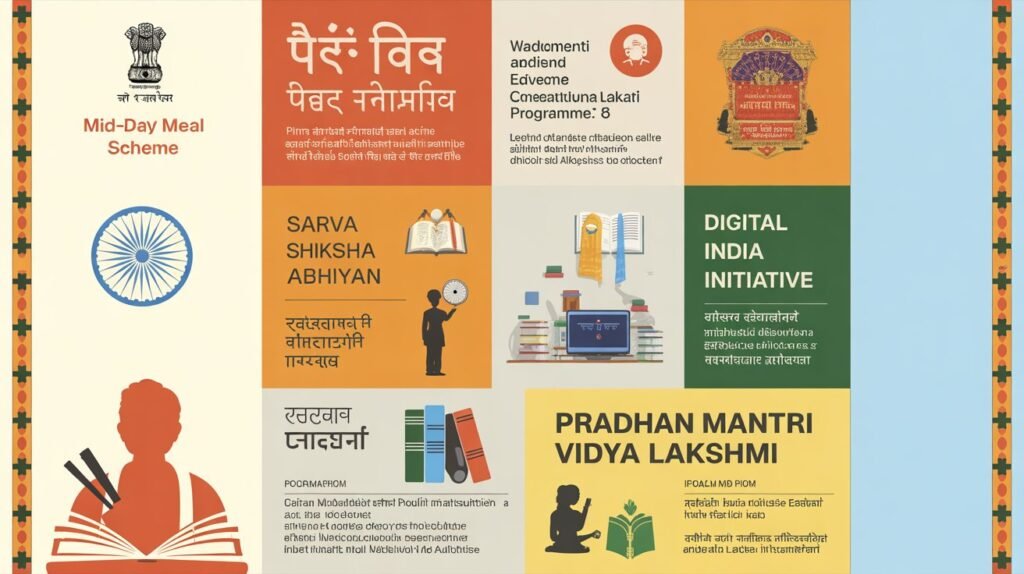
Government schemes for education in India span a variety of education system levels. There are those schemes targeted in primary and secondary education. The other ones are pro-college and professional education. Many programs work together. They want to enhance enrolment, curb dropouts, and learning outcomes. The sharing of responsibility is central to the state government. To succeed, they have to be coordinated.
Midday Meal Scheme and its effectiveness.
One of the most well-known things is the Midday Meal Scheme. It offers free meals to students in government and assistant schools. The goal is simple. Constrict emaciation and absenteeism. Hunger affects learning. Healthy meal makes children concentrated. The plan also motivates parents to take children to school on a regular basis. With time it has assisted in decreasing dropout rates. It also promotes social equality through uniting the children.
Educational and social advantages of Midday Meal Scheme.
Broadly speaking, the scheme has greater advantages than just nutrition. Children become more vital. Better attendance is experienced in schools. This has a good impact on girls, particularly in the rural regions. The local work provision is also facilitated by the scheme in the form of meal preparation. Quality and hygiene in food is monitored regularly.
Samagra Shiksha Abhiyan was elaborated.
An integrated education program is called Samagra Shiksha Abhiyan. It includes school education between pre-primary and class twelve. It has combined previous programs into a structure. This enhances coordination and planning. The plan is in favor of school facilities, educator preparation, and online education.
Areas of focus of Samagra Shiksha.
The assistance provided by the samagra Shiksha is in the form of classrooms, libraries and laboratories. It finances teacher development schemes. It enhances inclusiveness in education of children with special needs. Government schemes for education in India under this mission also encourage the use of technology in the classroom. There are digital content and smart boards that enhance engagement. The plan seeks to develop a solid background of lifelong learning.
Student scholarships in different categories.
One of the major elements of Government schemes for education in India is scholarships. They lighten up the family load. Scholarships help students in the economically weak groups. They are also the supporters of minority groups and deserving students. Most of the scholarships are the tuition fees, book fees, and living allowances. This assistance enables the students to pursue their studies without any strains.
They include categories of scholarships.
Government schemes for education in India have pre-matric and post-matric scholarships. Some are need-based. Others are merit-based. Girls and students with special needs have special scholarships. Applications have been reduced in complexity by digital portals. Transparency has improved. On time disbursement is a focus. Scholarships enhance the enrollment in higher learning.
Grants in tertiary education.
College may be costly. Government schemes for education in India cover a loan, fee remissions and grants. Interest subsidy is used to assist low-income students. Income-based loan repayments ease demands. Such actions prompt students to take up professional and technical courses. Grant money drives more people to join in other sectors such as engineering, medicine, and research.
Funding to skill and vocational education.
Very Vocational training by schools and colleges is becoming increasingly significant. Students are trained in job skills facilities and short courses. These programs are programs that connect education and employability. Training based on the industry enhances performance. The dependency on traditional degrees alone is also decreased by the skill education.
Education schemes Digital initiatives.
Much has been supported now with the help of digital tool. Internet-based learning platforms offer no cost content. Online classes increase accessibility. Students in distant regions have access to good resources. Online training takes place to teachers. Monitoring and data collection are improved with the help of technology. The programs make operations more efficient and transparent.
Intervention in education schemes by state governments.
A significant role is played by state governments. They change national schemes to local demands. Government schemes for education in India work when states utilize them successfully. Local language contents are better learning resources. The local monitoring enhances delivery. The collaboration between central and state is reinforcing results.
Implementation problems.
Nevertheless, there are problems despite the advances. The infrastructure gaps work on certain areas. Awareness regarding schemes is skewed. Government schemes for education in India should be strongly monitored. Trust can be impacted by delay in issuance of funds. Quality is also changed by teacher shortages. On-going assessment aids in the detection and improvement of problem.
Developing credibility by being open and effective.
The social programs require trust. Government schemes for education in India foster trust by articulate instructions and online technologies. The dashboards indicate progress to the populace. Audits act to enhance accountability. With results, there is increased participation by the families. Long-term is enhanced through transparency.
Long-term impact on society
Education programs manage the future generations in the country. Government schemes for education in India better literacy rates, skills, and social mobility. Learned citizens bring innovation and development. Social disparities decline with the years. Education enables people to make wise decisions. Classrooms are not the only way classes benefit in the long-term.
Conclusion
Government schemes for education in India define the inclusive learning. Since it is the Midday Meal Scheme, or Samagra Shiksha and scholarships, they are programs that tackle actual needs. Higher education dreams are sponsored by money. Digital tools expand reach. The problems are there, but development is continuous. As more emphasis is made on quality, access and accountability, Government schemes for education in India will still have a nonexistent future of making a more formidable force and one that is equally more fair.
FAQs
What are Government schemes for education in India?
They are social initiatives that facilitate the access, quality and affordability of education.
Who is the greatest beneficiary of these schemes?
Learners with low-income backgrounds, rural and underprivileged learners are the greatest beneficiaries.
What is the procedure of application of the education scholarships by the students?
Majority of them have portals in the upper domain, and the application procedures are basic.